

Patents Search
What are Patents?
Legal documents that grant their inventors protection and exclusive rights to their inventions for a limited period, thereby preventing competitors from registering the technology or any other innovative layer associated with the patent.
- Patents provide detailed information that is not always available in research articles.
- Patent rights are limited to the country in which they are granted.
- Patent families are groups of related patent documents from different parts of the world that cover the same or similar technical content.
Objectives of Using Patents in Research
- Update: Reviewing existing technology in comparison with current knowledge.
- Research: Identifying potential research partners or licensed inventors.
- Innovation: Monitoring new patents to support research aimed at commercial applications and the development of new technologies.
- Integrity: Searching prior information to avoid duplication and infringement of copyrights and intellectual property rights.
- Commercialization: Analyzing the technological landscape, market trends, and commercialization opportunities.
Patent Databases
Subscription-Based Patent Databases Provided by the Libraries and Information Division:
- Nexis UNI
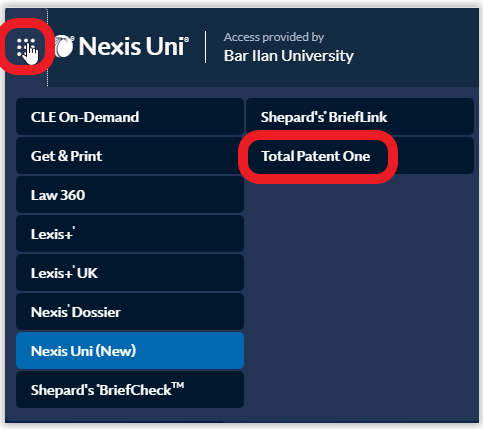
Nexis UNI – TotalPatent One
Full-text patent documents from around the world. Search is limited to the geographical sources of patents.
Please note: Under the current subscription, the database covers patents from five authorities:- Europe – European Patent Office. Includes information from nearly 40 European countries, including all European Union member states (EP).
- United Kingdom (GB)
- Japan (JP)
- United States (US)
- WIPO – Aggregates more than 5 million international patents.
For full details on database coverage, access the database, enter Nexis Uni and select TotalPatent One from the left-hand menu.
- Scopus
Scopus
Searching sources with the option to limit results to patents.
After performing a search and receiving results, select Patents from the bar above the results.
- IEEE Xplore
IEEE Xplore
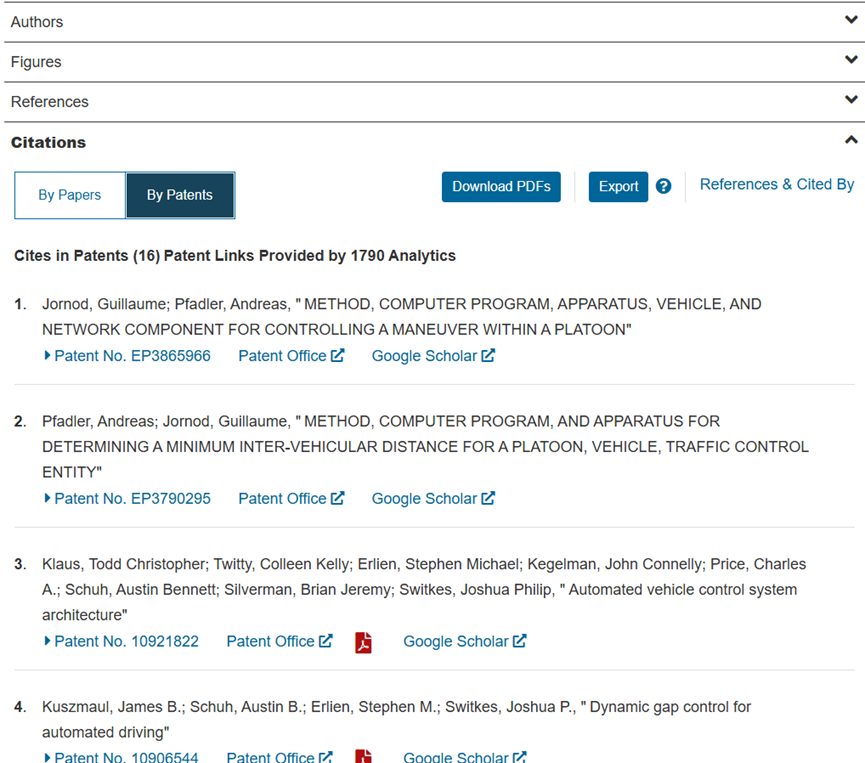
This database does not contain patents; however, in practice, search results that link to full text in HTML format make it possible to limit sources to patents via the publication’s citations.Below the details of each cited patent, a link is provided to the patent itself from the U.S., WIPO, and EPO patent databases.
- SciFinder
SciFinder
The database includes, alongside sources covering millions of articles and publications in the fields of chemistry and life sciences, records of patents and patent families from more than 70 patent authorities. Patents can be searched by full text, patent numbers, inventors and patent owners, CPC or IPC subject categories, compounds mentioned in the patent, Markush structures, patent status, and more.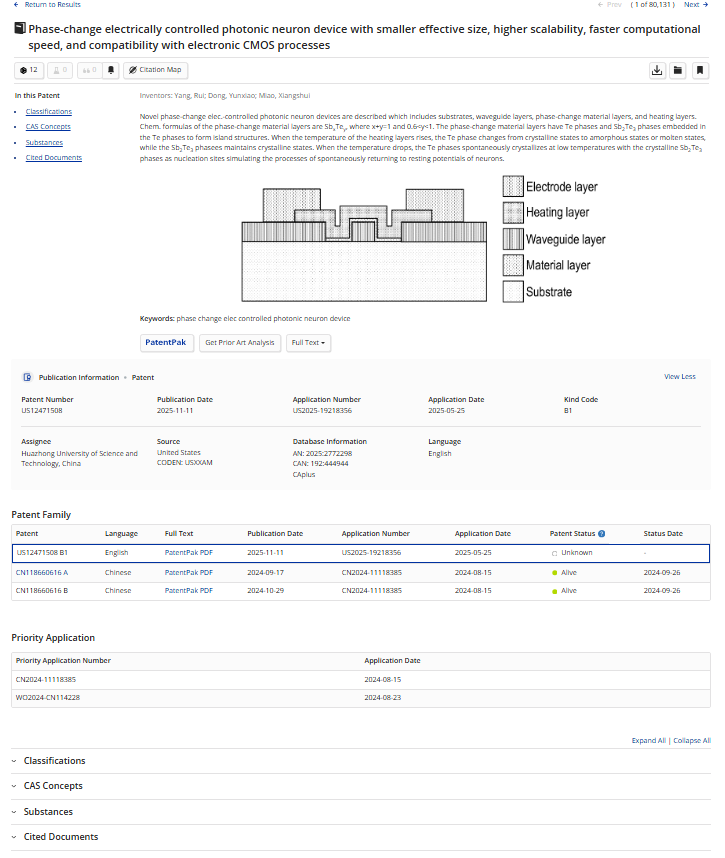
Open-Access Patent Databases:
- Google Patents
Google Patents
includes more than 120 million patents published worldwide, in addition to similar patents and related documents such as research articles and technical documents from Google Scholar, Google Books, and the Prior Art Archive.- EPO - European Patent Office- Espacenet
Espacenet
A database of the European Patent Office.
Provides access to more than 100 million patents and patent applications from over 90 authorities in Europe and around the world. Features advanced search capabilities.- USPTO
USPTO
Provided by the United States Patent and Trademark Office (USPTO).
Enables searching U.S. patent applications and granted patents, including full-text patents, accompanied by visual materials and bibliographic information. Allows advanced searches by inventor name, technology, and more.- WIPO PATENTSCOPE
WIPO
Provided by the World Intellectual Property Organization (WIPO).
Includes international patent applications filed under the Patent Cooperation Treaty (PCT), as well as national patent documents from various countries. Enables advanced searches using keywords, chemical compounds, numbers, and more.- CIPO
CIPO
Provided by the Canadian Intellectual Property Office.
Includes patents created over the past 155 years. Contains nearly 2.6 million patent documents, in addition to trademarks, copyright registrations, and more.- National Technical Reports Library
National Technical Reports Library (NTRL)
A large online database that aggregates technical reports and documents funded or produced by U.S. government bodies, which is also worth including in the list.- Israel Patents Online
רשות הפטנטים הישראלי
The database of the Israeli Patent Authority.
Contains up-to-date information on patents filed in Israel, as well as access to the current register of patent attorneys. Enables searching the database using various criteria and viewing patent application documents whose acceptance has been published, as well as applications opened for public inspection.
Additional Tools:
- Patents View
Patents View
Functions as a data and analytics platform based on USPTO patent data, developed for research, policy, and innovation analysis.- Perplexity - AI tool
Advantages:
- Natural‑language search, semantic understanding of alternative phrasings, and preservation of context for follow‑up questions.
- Ability to continue and integrate supporting documents in the answer with direct citations.
- Unlike searching in patent databases, it does not require precise Boolean syntax/fielded queries to achieve granular control.
- Expands the search beyond patents to include article repositories, open‑source code, and other public sources.
- Conversation‑driven results with semantic term expansion, summaries, and links to source documents. For example, “fitness trackers” will also retrieve “activity bands” and “health monitoring wearables” where there is a substantive connection, rather than only exact lexical matches typical of patent‑database searches.
- Suitable for rapid discovery and orientation, formulating follow‑up questions, and producing quoted summaries.
- Coverage is focused primarily on U.S. patents (USPTO), while various global public databases typically provide multi‑jurisdiction coverage. If broad, official territorial coverage across patent offices is required, combining a multi‑country public database remains important, with PERPLEXITY used to complement it for conversational queries, semantic expansions, and more.
- Many public/professional databases provide granular field filters such as publication number, priority date, IPC/CPC classifications, assignee/inventor, jurisdiction, legal status, language, and citation data. In PERPLEXITY, there are no field‑level limiters; the emphasis is on linguistic mediation capabilities.
Disadvantages:- Coverage is focused primarily on U.S. patents (USPTO), whereas many global public databases cover multiple jurisdictions. If broad official territorial coverage across patent offices is necessary, combine a multi‑country public database with PERPLEXITY for conversational queries and semantic expansion.
- Many public/professional databases offer granular field filters (e.g., publication number, priority date, IPC/CPC, assignee/inventor, territory, legal status, language, citation data). PERPLEXITY does not provide field‑based limiters and emphasizes language‑centric capabilities.
Comparative search example:
נושא: אילו פטנטים על מטריות מתקפלות עמידות לרוח
מילות מפתח: wind-resistant compact umbrellasTopic: Which patents cover wind‑resistant compact umbrellas
Keywords: wind‑resistant compact umbrellas- Perplexity: 5 results; suggests related terms; results from Google Patents and Google; links to patents + full‑text access; notes; Related.
- USPTO patent database: 35 results + navigation and refinement options.
- WIPO patent database: dozens of results. Placing one or both terms in quotation marks narrows to ~11–37 results.
Tip for combined workflow:
Start with PERPLEXITY using conversational phrasing to map terminology, concept families, and potential competitors. Then transfer the discovered vocabulary to authoritative patent databases to build precise fielded queries (e.g., date ranges, inventor/assignee, classifications) and additional filters.